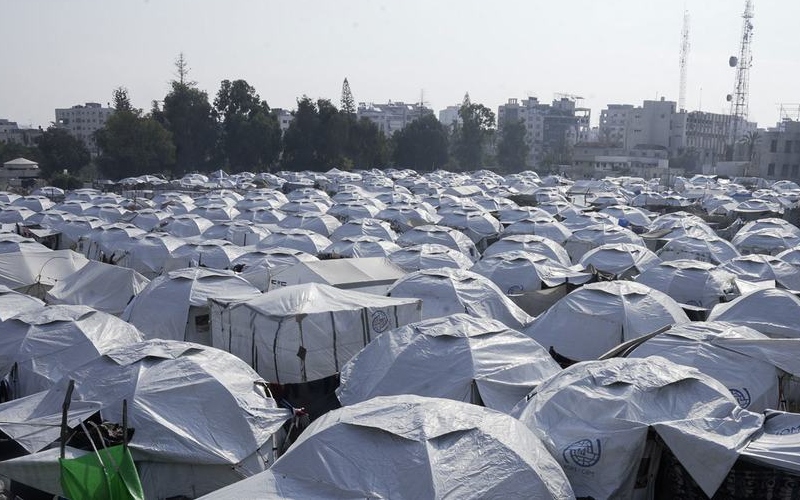
Heavy winter storms that hit Gaza in December have left thousands of families without safe shelter, deepening the humanitarian crisis in the region, the United Nations has said.
The UN Office for the Coordination of Humanitarian Affairs reported that around 65,000 households experienced damage or total loss of their shelters as rain and strong winds battered the area.
Families who were already struggling to survive in fragile conditions have been hit hardest.
“Tents were blown away or damaged, homes collapsed under storm conditions, and personal belongings were soaked,” OCHA said.
Entire displacement sites were flooded in several locations due to poor drainage and low-lying land, compounding the disaster.
The storms also damaged temporary schools and vital roads used to deliver humanitarian aid, making it more difficult for agencies to reach affected communities.
In December, relief efforts supported about 80,000 families, distributing more than 40,000 tents, over 135,000 tarpaulins, and other essential items like mattresses and blankets.
However, UN shelter partners noted that tents alone are not enough to provide long-term protection.
“Tents cannot serve as the primary and sole shelter modality in Gaza, as they provide only temporary cover,” they said, urging authorities and aid groups to move quickly toward repairing partially damaged homes and creating more durable solutions.
A shortage of land is delaying larger-scale shelter programs, while recent rainfall has undone some improvements made after a ceasefire in October 2025. The UN estimates that about one million people in Gaza still need urgent emergency shelter assistance.
Humanitarian teams have worked to improve emergency response, including delivering new radio equipment to strengthen communications, which had been awaiting Israeli approval since August 2024. However, other critical items, such as power-supply equipment, remain blocked, hampering relief work.
Tents provided by China, Egypt, and Saudi Arabia to house displaced Palestinians have shown limited resilience to storms. The Palestine Shelter Cluster, which coordinates nearly 700 NGOs and is chaired by the Norwegian Refugee Council, found that many of these tents “would likely need to be replaced.”
Only tents provided by Qatar, the United Arab Emirates, and the United Nations met UN standards.
“The fabric [of the Egyptian tents] tears easily as sewing quality is poor,” the assessment said. “The fabric is not waterproof. Other issues include small windows, weak structure, no flooring, the roof collects water due to the design of the tent, and no mesh for openings.”
Since the October 2025 ceasefire, only 20,000 of the 90,000 tents delivered to Gaza were supplied by the UN or major international NGOs.
Nearly all of Gaza’s 2.3 million residents have been displaced multiple times since fighting began in October 2023. Most areas remain in ruins, families have few resources to relocate, essential items are scarce, and basic services are largely unavailable.































Comments
Sign in with Google to comment, reply, and like comments.
Continue with Google